Pancreatitis & Mental Health: Coping Strategies for Patients & Caregivers
PART 2
In Part 1 of our mental health series, we talked about how pancreatitis affects mental health and why caring for your emotional well-being matters. Knowing why mental health matters alongside physical health is an important first step. New to our Mental Health Series? We recommend you start with Part 1.
Part 2 focuses on what you can do next using mental health frameworks recommended by Give an Hour’s subject-matter experts.
In Part 2, trauma-informed trainer and facilitator Julie Wells returns with realistic daily strategies for patients and caregivers. She covers how to talk to yourself with more kindness, how to make self-care part of routine practice and keep up with over time, how to build connections, and how to recognize when it’s time to seek professional support.
Topics covered:
- A framework for supporting your mental health
- Self-compassion and self-care
- Staying connected to others
- When to seek clinical help
- A new way forward
Free Tools to Support You
Alongside this video, we’re sharing five free toolkits we collaboratively developed with Give an Hour for the pancreatitis community. Use them at your own pace, and start with whichever one fits where you are right now.
Practicing Self-Compassion

A one-page guide to treating yourself the way you would treat a good friend. It breaks self-compassion into three parts (self-kindness, common humanity, and mindfulness), clears up what self-compassion is not, and lists simple ways to practice it. You can start with one, like placing a hand on your heart as you breathe or writing a short mantra to repeat on hard days.
Self-Care Practices

Start by circling the self-care practices you lean on most across six areas: physical, mental, emotional, nutritional, spiritual, and financial. Then use the checklist to find small additions, like taking time off without guilt, setting limits on your time and energy, or celebrating small wins. Pick one or two that feel doable this week and build over time.
My Support System
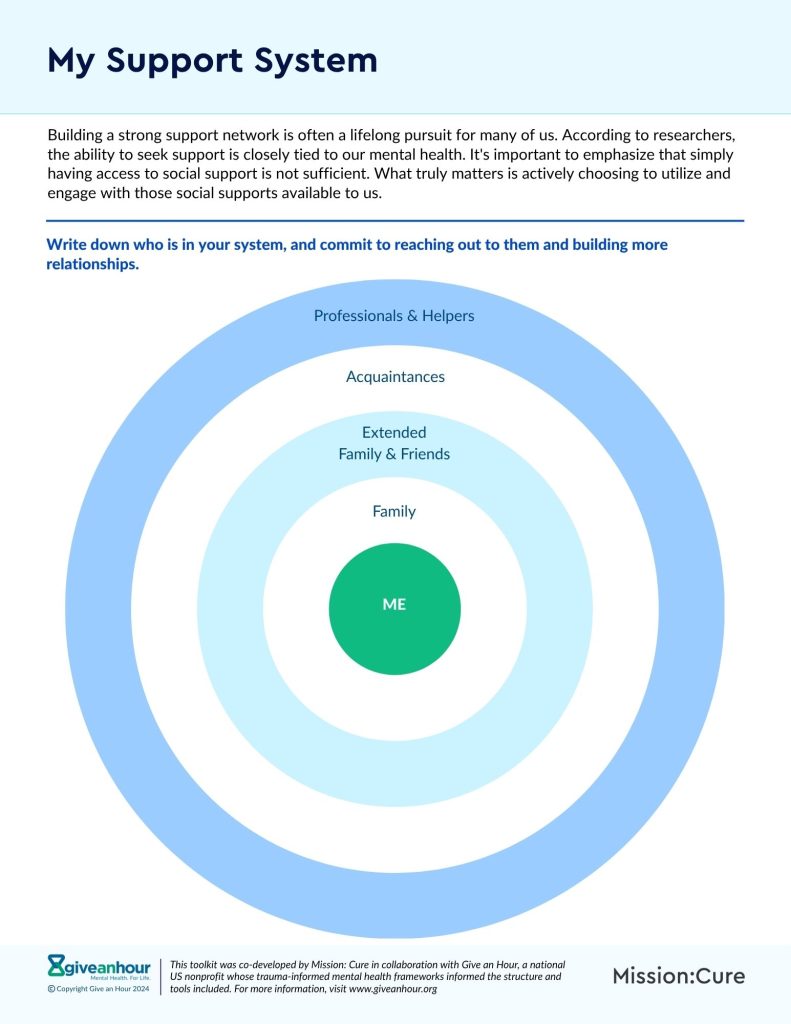
An expanded version of the Part 1 tool. Map the people in your life on a simple circle chart, from family at the center to professionals and helpers on the outside, then use the worksheet to note who’s in your corner, what you need, and where you want to grow. A third page explains five types of support (tangible, emotional, affirmational, informational, and belonging) with tips for building and keeping those relationships strong.
Finding Mental Health Support

A practical guide for patients and caregivers looking for a mental health professional. It covers who to look for (a therapist for emotional support, or a psychiatrist or nurse practitioner if medication may help), where to find trauma-informed providers, and questions to ask before and after your first session. It also lists support you can use while you wait, including the NAMI Helpline and 988. As the guide puts it, you don’t have to reach your breaking point to deserve support and to seek it.
Face the Five

A guide to five signs of emotional struggle. For each sign, it shows what it can look like so patients can self-identify and seek help, and it also offers words caregivers can use to start a conversation from a place of understanding and empathy. It’s written for patients and caregivers alike, and it’s especially helpful if you’re supporting someone who may not have the energy to ask for help.
Why This Matters
Mental health is part of being human, just like physical health; everyone has it, and it changes over time depending on what we’re going through.
When you’re living with pancreatitis, the emotional weight can be significant. The uncertainty. The grief. The exhaustion of advocating for yourself in medical settings. The fear of the next flare. The isolation that comes when your body limits what you can do and where you can go.
And for parents and caregivers of people with pancreatitis, the emotional burden is real, too. Research across rare and chronic diseases consistently shows significant mental health impacts on caregivers, especially those caring for children who may not have the words to describe what they’re experiencing.
We also know that mental health directly influences how we experience pain, how we manage symptoms, and how we engage with care. When emotional needs go unaddressed, living with a chronic condition becomes even harder.
This isn’t about adding more to your plate. It’s about recognizing that taking care of your mental health is part of taking care of yourself, and that small, intentional steps can make a real difference over time.
Our Expert Speaker

You're Not Alone
As Julie shares in this video, connecting with people who understand can ease the isolation that often comes with pancreatitis.
If you’re looking for community, here are a few places to start:
- Mission: Community to End Pancreatitis: our Facebook group for patients, families, and caregivers
- Genetic Pancreatitis Community Groups: Facebook groups for people with hereditary pancreatitis
- HealthUnlocked: Mission: Cure hosts and moderates an online Pancreatitis Support community accessed by patients and caregivers globally
For more options, see our guide to support groups and resources for pancreatitis patients.
If You're in Crisis
If you’re feeling distressed or having thoughts of harming yourself, please reach out for support.
- In the U.S.: Call or text 988 (Suicide & Crisis Lifeline), available 24/7
- Outside the U.S.: Please contact your local emergency services or crisis support line. Findahelpline.com has information for international support lines
You matter. Your life is valuable. And it’s okay to ask for help.
References
Gross, J. J. (2015). Emotion regulation: Current status and future prospects. Psychological Inquiry, 26(1), 1–26.
Neff, K., & Germer, C. (2018). The Mindful Self-Compassion Workbook. Guilford Press.
Neff, K. Self-Compassion. https://self-compassion.org/
Porges, S. W. (2011). The Polyvagal Theory. W. W. Norton.
van der Kolk, B. (2014). The Body Keeps the Score: Brain, Mind, and Body in the Healing of Trauma. Viking.
Waldinger, R., & Schulz, M. (2023). The Good Life: Lessons from the World’s Longest Scientific Study of Happiness. Simon & Schuster.
Walker, P. (2013). Complex PTSD: From Surviving to Thriving.
[APA (2020): full citation needed]
[Harvard Medical School (2019): full citation needed]
Keep Learning
Mission: Cure offers a growing library of free webinars, short form videos, blog posts, and tools to help people living with chronic or recurrent pancreatitis manage symptoms, reduce pain, and improve quality of life.
Check out our other resources featuring experts in pain management, nutrition, mental health, and more!