

Key takeaways
- Organoids are tiny, patient-derived 3D models of the pancreas grown from a person’s own tissue.
- In a new Salk Institute study, about half of the organoids tested had poor CFTR function, including some from patients with no CFTR mutation.
- The organoids sorted into three distinct biological subtypes that did not line up with the known causes of the disease.
- FDA-approved CFTR modulators improved CFTR function in the lab. This is a research finding, not a treatment available today.
Table of Contents
Finding new treatments for chronic pancreatitis has been challenging for many reasons, and one of them is because researchers haven’t had good ways and means to study the disease in the laboratory setting.
Before a potential treatment can be tested in people, scientists first need to understand how the disease actually works and find a safe way to test new ideas and medications before moving into clinical trials. Traditionally, researchers have relied on cells grown in flat layers in a lab dish or on animals. These approaches have taught us a great deal, but they don’t fully capture what happens inside a human body, more specifically, in our case, the pancreas. Pancreatic cells grown on a flat dish don’t behave the way they do inside the human body, and animal models can’t perfectly recreate conditions of a human disease.
A new study published in Cell Stem Cell may help change that. Researchers at the Salk Institute developed patient-derived pancreatic organoids, often called “mini organs.” These mini organs closely mimic the pancreatic ducts of people living with chronic pancreatitis. Using these organoids, they uncovered new clues about how the disease works and identified an FDA-approved class of drugs that may benefit some patients.
What are organoids?
Organoids are tiny, three-dimensional clusters of living cells grown from a patient’s own tissue.
Imagine taking a very small sample of pancreatic tissue and growing it into a miniature version of the pancreatic ducts in a laboratory. It isn’t a complete pancreas. It doesn’t contain every cell type or perform every function. But it behaves much more like real pancreatic tissue than cells grown in a flat layer on a petri dish.
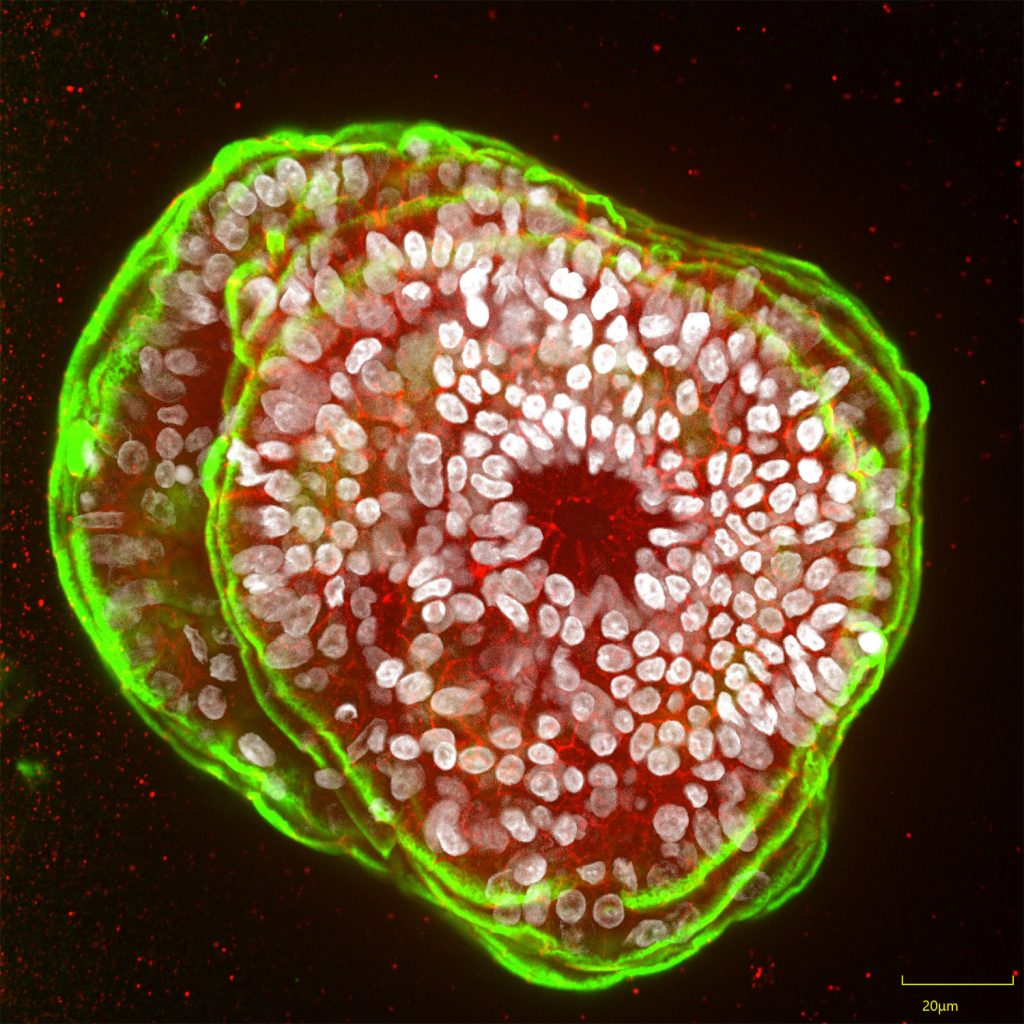
Healthy pancreas organoids that have been turned inside out to study their secretion. Each cell nuclei is white and the “edges” of the organoid that would typically be inward facing but now face outward are green. Credit: Salk Institute
This matters because chronic pancreatitis doesn’t look the same in every patient. The disease has many possible causes, including inherited genetic variants, metabolic conditions, autoimmune disease, and cases where the cause continues to remain unknown (idiopathic) despite a good cause assessment.
Even when two people receive the same diagnosis, the disease may not be driven by the same biological processes. Instead of studying an “average version” of chronic pancreatitis, organoids let researchers study a patient’s disease individually, which makes it possible to identify biological differences that may explain why one treatment works for some people but not others.
What did researchers do?
The research is led by Dannielle Engle, PhD, and her team at the Salk Institute. They created organoids from pancreatic tissue collected from 37 people with chronic pancreatitis. The participants represented multiple causes of the disease, including hereditary, alcohol-related, and idiopathic (unknown cause) pancreatitis. The researchers then compared these organoids with organoids grown from healthy pancreatic tissue.
They studied:
- How well the pancreatic duct cells functioned
- Which genes were turned on or off
- Whether patients shared common biological patterns
- How the organoids responded to medications that improve CFTR function

Victoria Osorio-Vasquez (left) and Dannielle Engle (right) develop a platform to generate patient-derived organoids that can be used to study pathogenesis and identify treatment strategies in chronic pancreatitis. Credit: Salk Institute
What did they find?
The CFTR link
One of the study’s most important findings involved a protein called CFTR.
You may recognize the CFTR gene because changes (mutations) in this gene can cause cystic fibrosis. But CFTR also matters for keeping the pancreas healthy. The CFTR gene carries the instructions for making the CFTR protein, which sits on the surface of pancreatic duct cells and helps move chloride and, especially, bicarbonate into the pancreatic ducts.
That job is important. The pancreas makes digestive enzymes, and those enzymes travel through a network of tiny tubes in the pancreas called pancreatic ducts on their way to the small intestine. The cells lining these ducts release bicarbonate and water, creating a fluid that carries the enzymes safely out of the pancreas. This bicarbonate-rich fluid also helps neutralize stomach acid once the enzymes reach the small intestine. When CFTR isn’t working as it should, less bicarbonate moves into the ducts, and the enzymes are not flushed out as they should be. Enzymes that activate too early can injure the pancreas and contribute to inflammation.
Some people develop chronic pancreatitis because they inherit changes in the CFTR gene.
But the researchers found something they did not expect.
Among the organoids they tested for CFTR function, about half showed poor CFTR function, and that included organoids from patients who had no CFTR mutation at all. In those cases, the CFTR protein wasn’t working properly even though the gene itself was not mutated.
This is important for patients. It suggests that impaired CFTR function may be more common than previously recognized. A genetic test on its own would miss some people whose CFTR is not working, and looking at how the cells actually behave might be an important step to determine function.
Biological subtypes
The researchers also discovered that the chronic pancreatitis organoids fell into three distinct biological subtypes, regardless of what originally caused the disease.
This finding suggests that chronic pancreatitis may actually include several different forms of disease rather than one single condition. In the future, identifying these subtypes could help researchers develop treatments that target the biology driving each person’s disease.
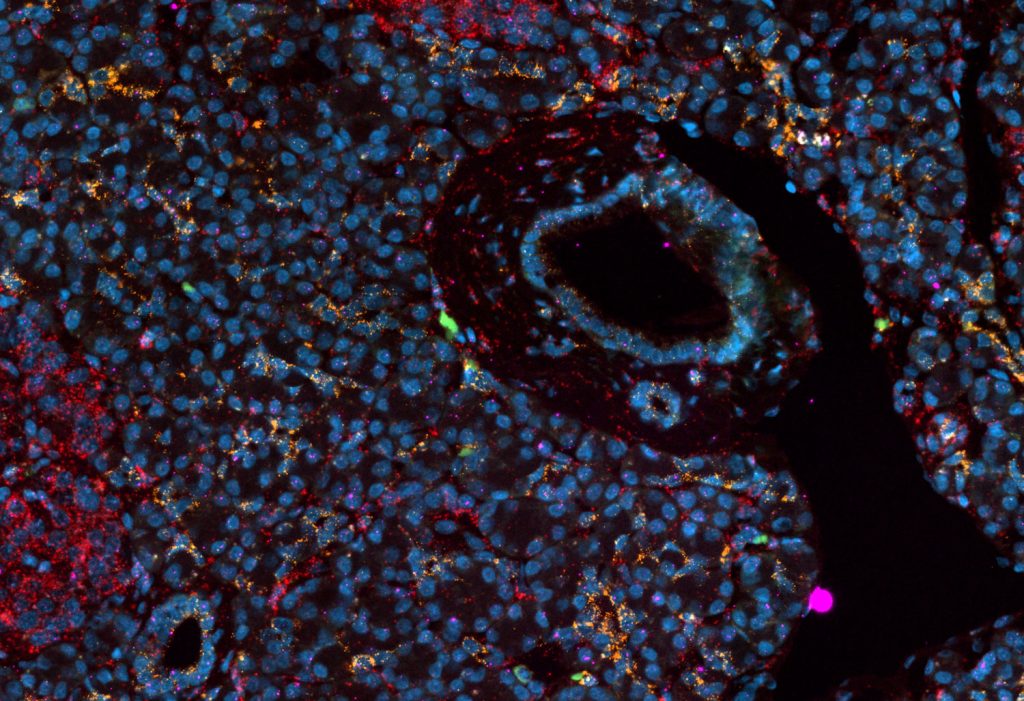
A human pancreas tissue section with markers (red, orange, green, pink) of different chronic pancreatitis subtypes identified by the Salk Institute team. Credit: Salk Institute
Could existing drugs help?
After identifying CFTR dysfunction, the researchers tested FDA-approved CFTR modulators, which are medications currently used to treat certain people with cystic fibrosis.
In the laboratory, these medications improved CFTR function in many of the chronic pancreatitis organoids. They also reduced inflammatory signaling within the pancreatic duct cells.
While these results are encouraging, it’s important to remember that they were observed in organoids, and not in patients.
More research, including clinical trials, will be needed to determine whether CFTR modulators improve symptoms, slow disease progression, or benefit specific groups of people with chronic pancreatitis.
Our new CFTR Modulators & Pancreatitis Evidence Hub brings together the published research to explore what we know so far. Read more about CFTR Modulators and pancreatitis.

Chronic pancreatitis patient-derived organoids proliferate. Cells actively undergoing cell division are orange while cells not actively dividing are turquoise. Credit: Salk Institute
Why this research matters
This study represents an important step toward precision medicine for chronic pancreatitis.
Instead of treating every patient the same way, organoids could help researchers sort chronic pancreatitis into subtypes and learn which subtypes respond best to which treatments. Over time, that kind of understanding could help match people with the therapies most likely to help them.
Patient-derived organoids could eventually help researchers:
- Better understand why chronic pancreatitis develops
- Identify different subtypes of the disease
- Test medications before clinical trials
- Predict which treatments are most likely to help individual patients
This research won’t change treatment options right away. What it offers is a powerful new tool. By creating patient-derived organoids that closely resemble the pancreas of people living with chronic pancreatitis, researchers now have a better way to study the disease and potentially identify treatments that can be tailored to each patient.
For a disease that has long lacked effective therapies, that’s an exciting step forward.
If you’d like to hear more about this research and the early development of these organoid models, you can listen to this conversation with Dr. Engle.
Our involvement
Mission Cure Capital helped fund Dr. Engle’s early work on chronic pancreatitis organoids focused on CA19-9. That work led to the insights on CFTR and pancreatitis behind this new study. We will keep following this work and share what comes next.
Mission Cure Capital (MCC) is an impact investing company that invests in high-impact, commercially promising treatments for pancreatitis and its symptoms. It is a separate entity from Mission: Cure but is mission-aligned in its focus on finding effective therapies for recurrent acute and chronic pancreatitis.
Reference
Osorio-Vasquez et al. Patient-derived organoids reveal ductal dysfunction and CFTR-modulator responses in chronic pancreatitis. Cell Stem Cell, 2026. https://doi.org/10.1016/j.stem.2026.06.002
About Mission: Cure
At Mission: Cure, we are dedicated to finding effective treatments and, ultimately, a cure for pancreatitis. Through patient education, research, and advocacy, we strive to improve the lives of those affected by this condition.
Get Updates in Your Inbox
Stay up-to-date on the latest Mission: Cure news and developments in pancreatitis care by signing up for our newsletter.